


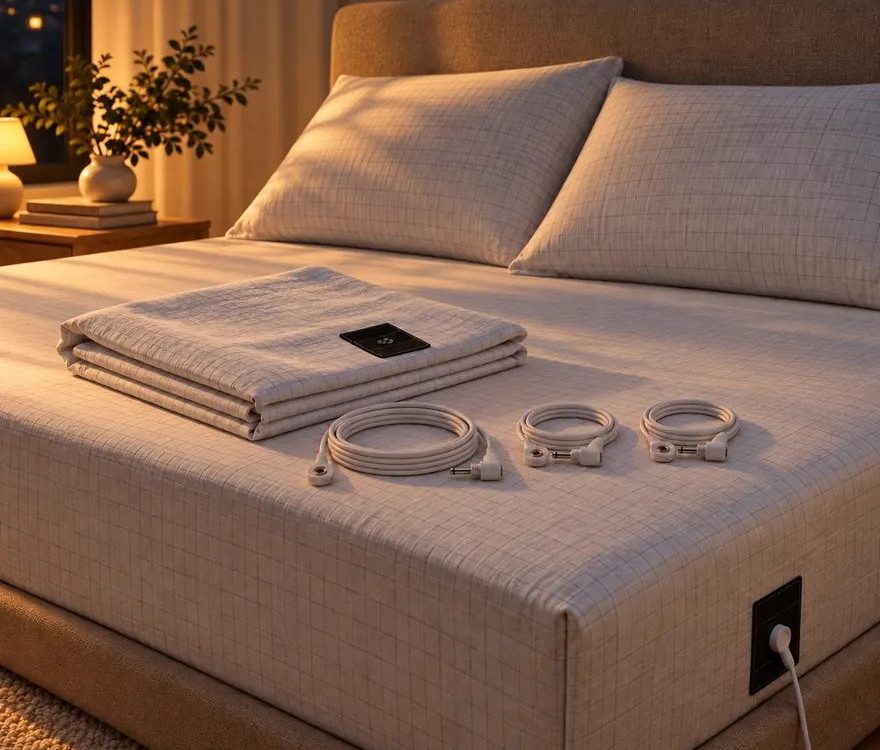
A grounding sheet looks and feels like an ordinary cotton sheet, but woven through it is a fine grid of conductive silver fiber. That fiber is the point of the sheet: it carries a connection from your skin, through a cord, to the ground port of a wall outlet. Anything that sits between your skin and the silver gets in the way. That is why washing a grounding sheet is a little different from washing everything else on the bed.
Key points
- Films from fabric softener, dryer sheets, lotions and oils can reduce contact with a sheet's conductive silver fiber.
- Unplug the cord, wash cold on gentle with mild detergent, skip bleach and softener, then tumble low or line dry.
- Wash grounding sheets weekly or at least every two weeks, and pillowcases weekly.
- Check the outlet with a plug-in outlet tester, and the sheet with the included conductivity tester or a multimeter.
The good news is that the right routine is simpler than most laundry, not more complicated. It mostly comes down to what you leave out.
Why care matters for silver fiber
Silver conducts well when its surface is bare. Over a week of sleep, a sheet collects skin oils, sweat, lotion, and whatever is in your hair. Laundry products can add another layer. Fabric softeners work by depositing positively charged compounds that bind to fibers and form a thin, slick film; that film is what makes fabric feel soft and reduces static. Dryer sheets leave a similar coating. On ordinary cotton that is harmless. On a conductive sheet, a film over the silver means less direct contact.
Manufacturers of silver-threaded grounding sheets are blunt about this. Earthing, a maker of grounding products, says in its care guidance for its silver-threaded sheets that bleach, fabric softener, dryer sheets, whitening or oxygen-based detergents, and detergents containing oils would make the silver threads nonconductive. It also suggests waiting about an hour after applying lotion or body oil before getting into bed.
Washing itself is a balance. Lab research on silver-coated textiles shows they wear with use. A 2023 study in RSC Advances by Sohyun Park, Hyewon Kim and Suhyun Lee found that repeated washing physically rubbed silver from the surface of a conductive knit fabric, and that sweat reacted with the silver and changed its color. A 2024 follow-up by Lee and Park in the same journal compared wash settings on a silver-coated nylon fabric: the hottest wash (60 °C) caused the most damage, and machine drying caused more cracking and peeling of the silver layer than air drying. Those studies used a single synthetic fabric over a limited number of cycles, not a woven cotton sheet, so they are a guide to direction rather than a prediction for any one product. The direction is consistent, though: cooler water, gentler handling and less heat are kinder to silver.
So the aim is to wash often enough to keep oils from building up, and gently enough not to wear the fiber.
How to wash, step by step
This follows Velin's care guide for the Equilibrium Grounding Fitted Sheet and Equilibrium Grounding Pillowcase. Always check the label on your own sheet first.
- Unplug first. Unplug the cord from the outlet and disconnect it from the sheet before you strip the bed. The cord never goes in the wash.
- Wash cold on a gentle cycle. Cold water and a delicate or gentle setting limit the friction and heat that wear conductive fiber.
- Use a small amount of mild detergent. A plain liquid detergent, without added softeners or oils, is best. More detergent does not mean cleaner; it can leave residue.
- Leave out bleach, fabric softener and dryer sheets. Bleach is harsh on silver, and softeners and dryer sheets coat the fiber.
- Wash with similar soft items. Avoid washing with heavy items, zippers or hook-and-loop fasteners that can abrade the fabric.
- Tumble dry low or line dry. Low heat is fine. Line drying is gentlest. Remove the sheet promptly when dry.
So the aim is to wash often enough to keep oils from building up, and gently enough not to wear the fiber.
How often to wash
Wash grounding sheets weekly, or at least every two weeks. Pillowcases should be washed weekly, because hair products, face creams and skin oils collect there fastest. Earthing gives similar guidance for its silver-threaded sheets: weekly, or at least twice a month.
If you use lotion or body oil at night, try applying it earlier in the evening so it has time to absorb before you lie down. It keeps the sheet cleaner between washes.
Detergents and additives to avoid
Many detergents now include softeners, scents and other additives, so it is worth reading the label. Avoid:
- "2-in-1" detergents with built-in softener, for the same reason you skip liquid softener.
- Bleach, including chlorine bleach.
- Oxygen-based ("oxi") and whitening detergents, which Earthing lists among products that can make silver threads nonconductive.
- Detergents with added oils, such as lavender or coconut oil.
- Dryer sheets and fabric softener in any form, including scent beads that are meant to cling to fabric.
If softener or a 2-in-1 detergent has already gone through with your sheet, washing again in plain mild detergent is a reasonable first step. There is no reliable public research on whether or how quickly residue washes out, so the practical test is the one below.
How to check conductivity
There are two separate things to check: the outlet and the sheet.
Check the outlet first
A grounding cord connects only to the ground port of a standard three-prong outlet, and it only works if that outlet is properly grounded. A plug-in outlet tester, sold at any hardware store, checks this. Plug it into the outlet you plan to use and compare the lights with the legend printed on the tester. If the pattern shows anything other than correct wiring, such as an open ground, don't use that outlet and have an electrician look at it.
Then check the sheet
To check the fabric itself, you can use a continuity tester or a basic multimeter set to continuity mode. A continuity test checks whether there is an unbroken path for current between two points; as Fluke explains in its guide to multimeters, the meter beeps when the path is complete and stays silent when it is open. Touch one probe to the snap or connection point on the sheet and the other to an area of the fabric, and listen for a beep. If the sheet used to test well and no longer does, try a wash in plain mild detergent and test again. If it still doesn't, check the cord.
Caring for the grounding mat and cord
The Equilibrium Grounding Mat needs even less. Wipe it with a damp cloth and plain water, then let it air dry. Avoid lotions, oils and alcohol-based cleaners, which can leave a film or damage the surface. Keep it clean and dry between uses, and wipe off any skin products before they build up.
Cords take quiet abuse: they get pinched in bed frames, run over by vacuum cleaners, and bent tightly at the plug. A few habits help:
- Route the cord where it won't be crushed by furniture or stepped on.
- Coil it loosely when it's not in use; avoid sharp kinks near the plug and snap.
- Unplug it by holding the plug, not by pulling the cord.
- Look it over now and then for cracks, fraying or loose connectors.
Replace the cord if it is visibly damaged, if a connector no longer seats firmly, or if your outlet tests correctly but the sheet or mat no longer shows continuity through the cord. Velin sells a replacement grounding cord separately, so a worn cord doesn't mean replacing the sheet.
From the Equilibrium collectionEquilibrium Replacement Grounding CordSold separately, so a worn or damaged cord doesn't mean replacing the sheet.View productA note on safety
Connect grounding cords only to the ground port of a properly grounded outlet, and test the outlet before use. If you have an implanted medical device, are pregnant, or take blood thinners, talk to your doctor before using grounding products.
For care instructions for every Velin product in one place, see our care guides. To learn more about the fiber itself, read why silver.
Sources
- Park S, Kim H, Lee S. Changes in characteristics of silver conductive fabrics owing to perspiration and washing. RSC Advances, 2023.
- Lee S, Park S. Optimizing washing conditions for smart fabrics: a comprehensive study. RSC Advances, 2024.
- Earthing. How do I wash my silver-threaded Earthing sheet?
- Fluke. A guide to continuity testing with a multimeter.
- Fabric softener, Wikipedia (overview of how cationic softeners bind to fibers).
This article is for general information and isn't medical advice. Individual results vary.
