


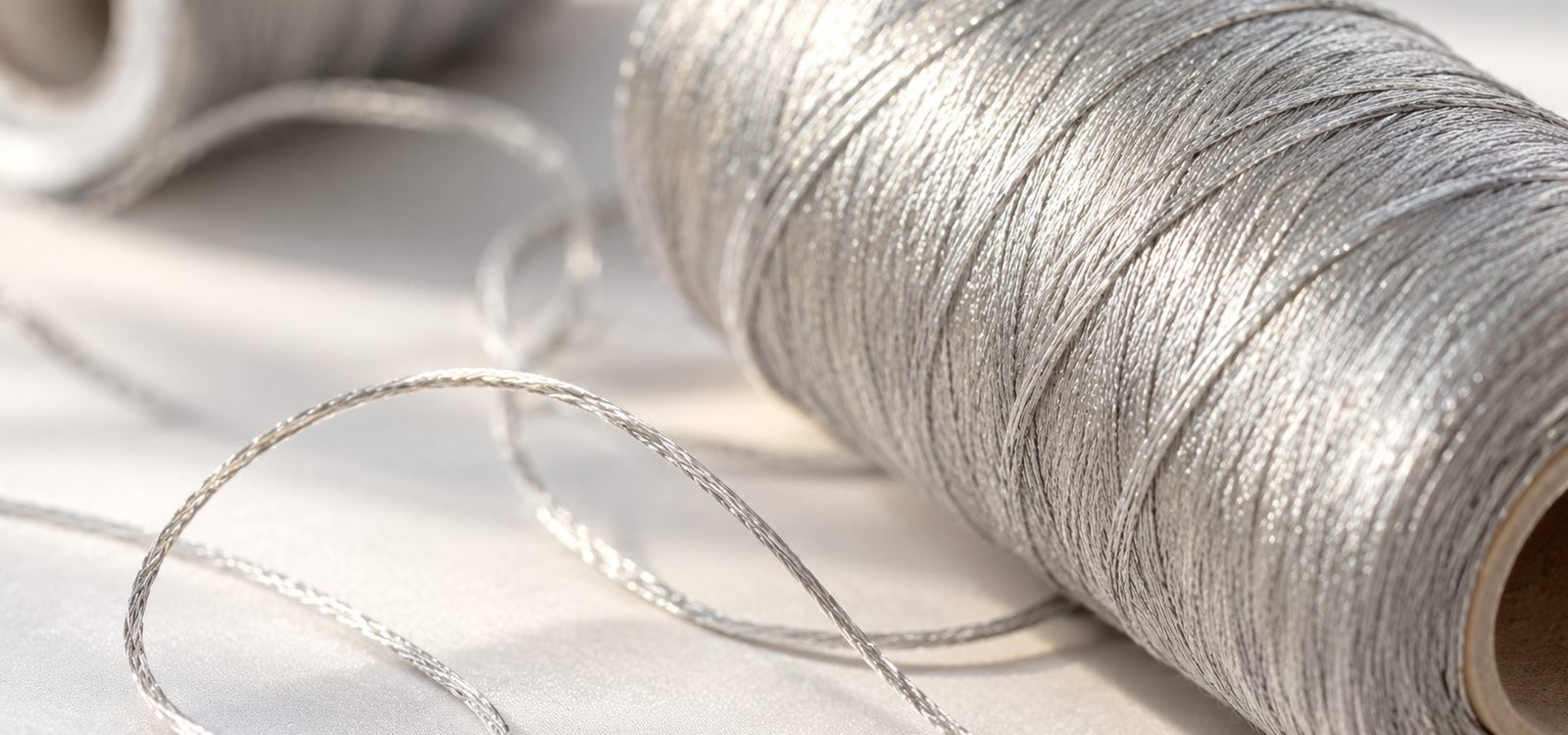
Sheets pick up something from every night you sleep in them: sweat, skin oils and the bacteria that feed on both. Much of the stale smell a bed develops between washes comes from those bacteria breaking down what we leave behind. Silver has been added to fabric to slow that process down, and it has a longer history than most textile finishes.
Key points
- Silver in fabric helps resist odor-causing bacteria in the fabric itself; under EPA rules it doesn't protect people from germs.
- How silver is attached matters: in one Empa study, single-wash losses ranged from under 1% to 45%.
- Lab tests like AATCC 100 and ISO 20743 don't guarantee real-world results; OEKO-TEX STANDARD 100 doesn't measure freshness.
- Silver-treated sheets are meant to stay fresher between washes, not to replace washing.
This piece covers where silver's reputation comes from, how it works in a sheet, how it's tested, and what questions it raises. It also explains what silver-treated bedding is not.
A very old material with a reputation
People were using silver to keep things fresh long before anyone knew bacteria existed. In a 2009 review in Surgical Infections, surgeon J.W. Alexander wrote that silver has been used for at least six millennia to prevent microbial infections, and he called it the most important antimicrobial agent available before antibiotics arrived in the 1940s. Historical accounts describe water and other liquids kept in silver vessels, and later, silver foil and silver compounds applied to wounds.
That history is real, but it is also a history of medicine, not of bedding. Whether medical silver products help healing is still debated: a consensus document published by Wounds International notes that two Cochrane reviews found insufficient evidence that silver dressings improve healing rates. For sheets, the useful takeaway is narrower. Silver is a long-studied material that bacteria do not tolerate well.
How silver works in a fabric
The active form is the silver ion (Ag+), which metallic silver releases slowly when it meets moisture. In a 2008 laboratory study in Applied and Environmental Microbiology, Woo Kyung Jung and colleagues exposed E. coli and Staphylococcus aureus to a silver ion solution and used electron microscopy to watch what happened. The cell membranes pulled away from the cell walls, and the cells lost the ability to take up nutrients and divide. The researchers were candid that the full mechanism is not understood, and their work was done in a lab solution, not on fabric.
In a textile, the goal is more modest. Silver in the fibers helps the fabric resist the growth of odor-causing bacteria in the fabric itself. That's the claim the industry is allowed to make. Under the U.S. Environmental Protection Agency's treated-articles guidance (PR Notice 2000-1), a product treated with an antimicrobial substance can claim to protect the article itself, such as resisting odor or mildew in the fabric, but not to protect people from germs or disease. EPA-accepted labels for silver textile treatments state this directly: they don't protect users against bacteria, viruses or other disease organisms.
Fiber-level silver vs. coatings
Silver gets into fabric in a few ways. It can be applied as a finish or coating after the fabric is woven, it can be plated onto fibers, or it can be built into or bonded to the fiber before the yarn is made. How it's attached matters most for one practical question: how much stays in the sheet after it's washed.
The clearest data comes from a 2009 study by Lea Geranio, Manfred Heuberger and Bernd Nowack at Empa, the Swiss materials research lab, published in Environmental Science & Technology. They washed nine commercial silver textiles, each made a different way. The share of silver released in a single wash ranged from under 1% to 45%, depending on how the silver had been incorporated. Most of it came off as larger particles knocked loose by mechanical action, and coverage of the study reported that most of the loss happened in the first wash. Bleaching agents such as hydrogen peroxide greatly sped up the dissolving of silver.
The lesson for shoppers is that "contains silver" says little on its own. Silver that is bonded at the fiber level is intended to hold up through laundering better than a surface finish, and avoiding bleach helps any silver fabric keep what it has.
What the lab tests show, and what they don't
Two lab methods come up most often. AATCC 100, the common North American method, and ISO 20743, its international counterpart, both work the same basic way. A lab places a measured amount of bacteria on a treated fabric and on an untreated control, incubates both for roughly a day, and compares how many bacteria remain. ISO 20743 offers several ways of applying the bacteria, and its absorption method is closest to AATCC 100. Results from the two aren't directly interchangeable.
These tests are useful for confirming that a fabric does something under controlled conditions. They have limits. Neither test on its own measures durability through washing, so look for results after a stated number of launderings. And a lab result does not guarantee the same effect on a bed. In a 2013 study in The Journal of the Textile Institute, Rachel McQueen and colleagues had eight men wear silver-chloride-treated polyester against their underarms. Even though the fabric showed antimicrobial activity in the lab, it didn't reduce odor intensity or bacterial counts compared with untreated fabric in wear. The authors concluded that lab results don't necessarily predict real-world performance. That was one finish on polyester in a small study, but it's a fair caution for any silver product.
The lesson for shoppers is that "contains silver" says little on its own.
What OEKO-TEX STANDARD 100 means
OEKO-TEX STANDARD 100 is often mentioned alongside silver, and it answers a different question. It doesn't measure freshness. It certifies that every component of a textile, from thread to buttons, has been tested by an independent institute against a list of more than 1,000 substances that can harm human health, with limits that tighten as skin contact increases. Bedding falls in Product Class 2, for items worn or used directly against the skin.
Certificates are issued for one year, and you can check one by entering its number in OEKO-TEX's online Label Check. What the label does not cover is how the fabric was produced; environmental and social production standards are separate programs.
The environmental questions
Silver that leaves a fabric goes somewhere, usually down the drain. The Empa study found that most silver released in washing came off as relatively coarse particles, and its authors argued that regulators should look at all silver textiles rather than singling out "nano" products. A later risk assessment by Rickard Arvidsson and colleagues at Chalmers University of Technology, published in Human and Ecological Risk Assessment in 2014, modeled silver from clothing reaching a wastewater plant in Gothenburg. They found no expected risk at low silver levels, but at high levels the sludge spread on farmland could harm earthworms. Their recommendation was that silver in clothing be kept at the low end of the range.
There's also the question of payoff. A 2015 review and life-cycle analysis by Andrea Hicks and colleagues in Environmental Science & Technology noted that laundering accounts for much of a silver textile's environmental impact, so any benefit depends on people actually washing less often. The authors found that reducing the overall impact is not straightforward. A fair summary: low silver content, durable bonding and sensible washing all matter.
What it means in your bed
In practical terms, silver-treated sheets are meant to stay fresher between washes. They are not a reason to stop washing. Sweat, oils and skin cells still build up, and only laundering removes them. Velin's Care Guide recommends washing sheets weekly or at least every two weeks, in cold water with a mild detergent and without bleach or fabric softener.
Our SilverThread Sheets use GOTS certified organic long-staple cotton in a twill weave, with silver bonded at the fiber level, OEKO-TEX STANDARD 100 certified and SGS tested. Silver in those sheets is there to help the fabric resist odor-causing bacteria.
That's a different job from the silver in our Equilibrium Grounding Fitted Sheet. There, conductive silver fiber is woven through GOTS certified organic cotton so the sheet can carry an electrical connection through a cord to the ground port of an outlet. The same metal is used for two separate properties: in one, its effect on bacteria in the fabric; in the other, its conductivity. You can read more about the second in What Is Grounding?
From the Equilibrium collectionEquilibrium Grounding Fitted SheetConductive silver fiber woven through GOTS certified organic cotton, carrying a connection by cord to an outlet's ground port.View productSources
- Alexander JW. "History of the medical use of silver." Surgical Infections, 2009;10(3):289–292. pubmed.ncbi.nlm.nih.gov/19566416
- Wounds UK. Column on the history of silver in wound care (citing Alexander). wounds-uk.com
- Wounds International. Consensus document on silver dressings. woundsinternational.com
- Jung WK, Koo HC, Kim KW, Shin S, Kim SH, Park YH. "Antibacterial Activity and Mechanism of Action of the Silver Ion in Staphylococcus aureus and Escherichia coli." Applied and Environmental Microbiology, 2008;74(7):2171–2178. PMC2292600
- U.S. EPA. "PRN 2000-1: Applicability of the Treated Articles Exemption to Antimicrobial Pesticides." epa.gov (archived)
- U.S. EPA. Accepted label, SilvaClean silver textile treatment (EPA Reg. No. 90335-1). epa.gov
- Geranio L, Heuberger M, Nowack B. "The Behavior of Silver Nanotextiles during Washing." Environmental Science & Technology, 2009;43(21):8113–8118. EPA HERO record
- ScienceDaily. Coverage of the Empa washing study, October 2009. sciencedaily.com
- Eurofins. "Testing standards of antimicrobial treatment for textile products." eurofins.com
- Microchem Laboratory. "ISO 20743 – Assessment of Antibacterial Finished Products." microchemlab.com
- McQueen RH, Keelan M, Xu Y, Mah T. "In vivo assessment of odour retention in an antimicrobial silver chloride-treated polyester textile." The Journal of the Textile Institute, 2013;104(1):108–117. agris.fao.org
- OEKO-TEX. "OEKO-TEX STANDARD 100." oeko-tex.com
- Arvidsson R, Molander S, Sandén BA. "Assessing the Environmental Risks of Silver from Clothes in an Urban Area." Human and Ecological Risk Assessment, 2014;20(4):1008–1022. research.chalmers.se
- Hicks AL, Gilbertson LM, Yamani JS, Theis TL, Zimmerman JB. "Life Cycle Payback Estimates of Nanosilver Enabled Textiles under Different Silver Loading, Release, and Laundering Scenarios Informed by Literature Review." Environmental Science & Technology, 2015;49(13):7529–7542. scholars.duke.edu
This article is for general information and isn't medical advice. Individual results vary.
