


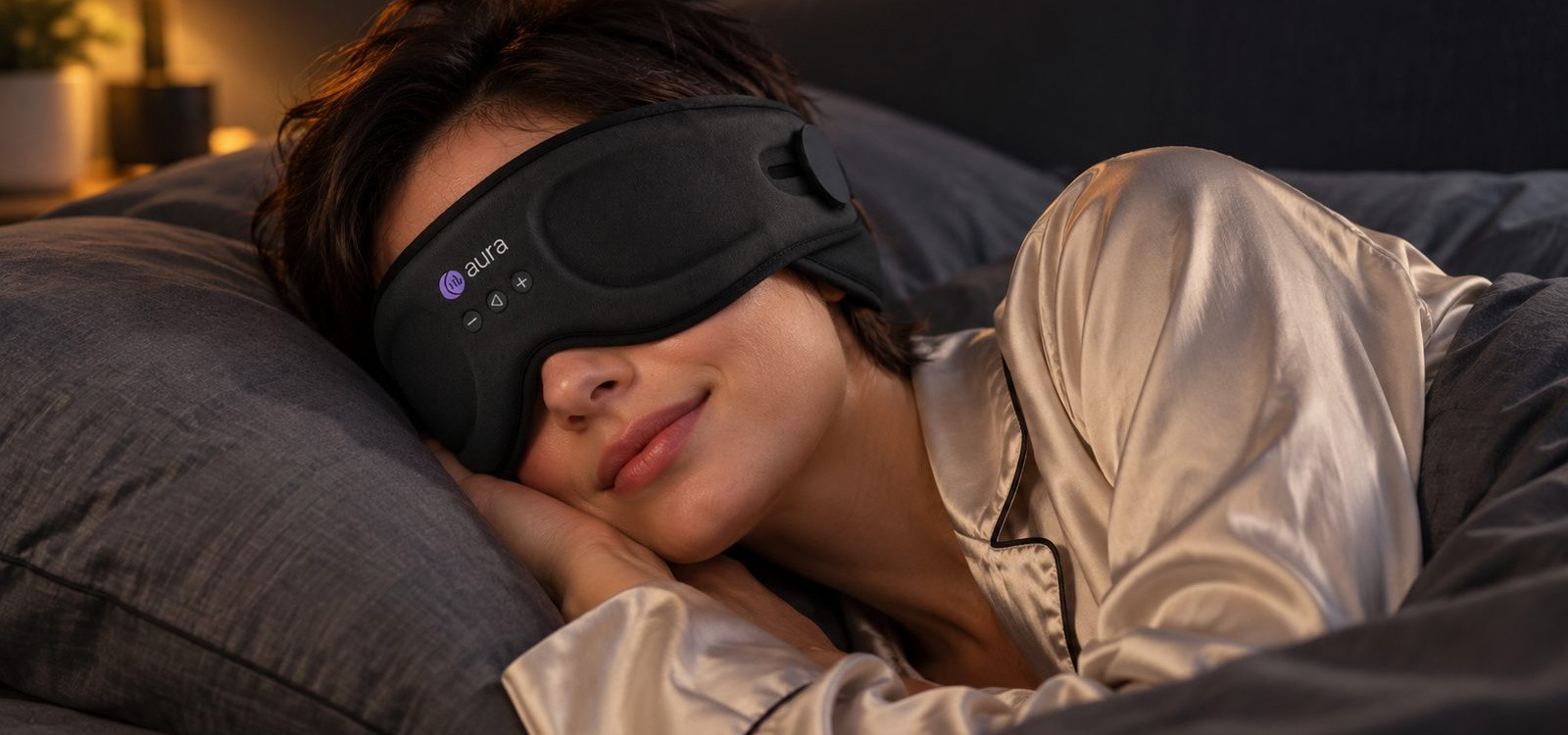
Lie on your side in a typical sleep mask and you will usually feel it within minutes: the pillow pushes the mask into your cheekbone, the strap rides up, and a seam of light appears at the bridge of your nose. Masks are mostly designed around a face looking at the ceiling. If you spend the night facing the wall, the details that matter are different.
Key points
- Studies link room light before and during sleep to melatonin and heart-rate changes, though they were small or lab-based.
- Side sleepers should look for contoured cups, thin flexible temples, and a strap that sits above the ear.
- Earbuds can press into the ear overnight; thin speakers built into a mask sit over the ear instead.
- Keep audio low, about half to 60 percent of maximum volume, and use a sleep timer.
This guide covers why darkness is worth the effort, what a side sleeper should look for in a mask, how built-in audio compares with earbuds, and a short checklist for choosing one.
Why light at night matters
The body uses light as its main signal for time of day, and melatonin, the hormone that rises in the evening, is sensitive to it. A study by Joshua Gooley and colleagues, published in The Journal of Clinical Endocrinology & Metabolism in 2011, compared melatonin profiles in 116 healthy adults aged 18 to 30 when they lived in ordinary room light (under 200 lux) and in dim light (under 3 lux). Room light before bedtime delayed the rise of melatonin in nearly all participants and shortened its nightly duration by about 90 minutes. Room light during the usual hours of sleep suppressed melatonin by more than 50 percent in most trials. The study was a retrospective analysis of young adults in a lab, so it says more about mechanism than about any one bedroom.
Light during sleep may also affect the body in other ways. In a 2022 study in PNAS, Ivy Mason, Phyllis Zee and colleagues at Northwestern University had 20 young adults sleep one night under moderate overhead light (100 lux) and compared them with dim-light sleep. Heart rate stayed higher in the lit room, and the next morning participants showed greater insulin resistance on a glucose test. Melatonin levels were similar in both groups, which the authors took to point toward nervous system activation rather than melatonin. It was one night and a small group, and the researchers present it as a reason to keep bedrooms dark rather than as proof of long-term harm.
There is some direct research on masks themselves. In a paper published in Sleep (Greco and colleagues, 2023), 94 young adults wore a light-blocking eye mask for one week and, for comparison, spent another week either without a mask or wearing one with holes cut over the eyes. With the light-blocking mask, participants did better on a word-pair memory task and reacted faster on an alertness test. A second, smaller experiment of 37 people found a similar memory result. The participants were all 18 to 35, and the authors note more work is needed in other groups.
A mask you take off at 2 a.m. does nothing.
What side sleepers need from a mask
A mask you take off at 2 a.m. does nothing. For side sleepers, comfort comes down to a few design choices.
Contoured eye cups
Flat masks press directly on the eyelids, and that pressure increases when your face is turned into a pillow. Contoured, or molded, masks have shallow cups that arch over the eyes so the fabric rests on the brow and cheekbones instead. Look for cups deep enough that you can blink freely, but not so tall that they add bulk at the side.
A low profile at the temples
The part of the mask that matters most for side sleeping is the band between the eye and the ear. Thick foam or a rigid frame here becomes a pressure point against the pillow. A thin, flexible edge lets the mask fold with your face instead of levering away from it, which is also what keeps light from leaking in.
Strap placement and adjustment
A strap that sits directly over the ear presses the ear against your head when you lie on it. A strap that sits slightly higher, around the back of the crown, tends to stay put and avoids the ear. Wide, soft straps spread pressure better than thin elastic, and an adjustable closure lets you set the tension just firm enough to seal out light. Hook-and-loop fasteners should sit at the back of the head, away from the pillow side, and not catch hair.
Materials and breathability
The face gets warm under a mask, especially when half of it is against a pillow. Breathable, soft-faced fabrics and a little ventilation around the nose help. A good seal at the nose bridge is the hardest part of blocking light; a mask that fits snugly there without pressing on the nose is worth looking for.
Audio in a mask vs. earbuds
Many people fall asleep to white noise, rain sounds, or a podcast. The question for side sleepers is where the speaker sits.
Earbuds go into the ear canal, and the pillow presses them deeper. Cleveland Clinic, quoting audiologist Valerie Pavlovich Ruff, AuD, notes that earbuds can press into the ear overnight for side sleepers and cause pain and irritation, can push earwax deeper into the canal, and can trap moisture that raises the risk of outer ear infections. Its suggested alternatives include headphones designed for sleep, such as headband styles, or a speaker near the bed.
Thin speakers built into a mask sit over the ear rather than inside it. The thinner they are, the less they press when you lie on them. This is the idea behind the Aura Sleep Mask, which combines a contoured, light-blocking mask with ultra-thin removable speakers designed for side sleepers. It weighs 113 g and plays for about 10 hours on a charge.
Whatever you use, volume matters more than the device. The World Health Organization advises keeping personal audio at no more than 60 percent of maximum volume and notes that a sound level of 80 decibels is safe for up to 40 hours a week, with the safe time dropping sharply as levels rise. Cleveland Clinic suggests keeping bedtime audio at about half volume or lower, using a sleep timer so sound stops after you fall asleep, and avoiding noise-canceling modes that could keep you from hearing an alarm. Sleep audio is meant to be quiet; if you have to turn it up to hear it, the room may be the thing to fix.
From the Aura collectionAura Sleep MaskContoured light-blocking mask with ultra-thin removable speakers for side sleepers; about 10 hours of play.View productBattery and cleaning
A mask with audio needs to last the night. About 10 hours of play covers a full sleep with some margin, and a sleep timer stretches a charge further. Charge it during the day rather than at bedtime so a low battery doesn't wake you.
Masks sit on skin for hours, so they collect oils, sweat and any face products you use. Wash them regularly, following the care instructions. For any mask with electronics, remove the speakers and module before washing. The Aura is hand wash only, with the speakers and module taken out first; let it dry fully before putting them back.
A short checklist
- Contoured cups that clear your eyelids and let you blink.
- Thin, flexible sides at the temples, with no rigid frame.
- A strap that sits above the ear, wide and adjustable, with the fastener at the back.
- A snug nose bridge that blocks light without pressing.
- Breathable, soft fabric against the face.
- If it has audio: speakers thin enough to lie on, enough battery for a full night, and a sleep timer.
- Easy cleaning: removable electronics and a washable mask.
- Low volume: no more than about half to 60 percent of maximum, per Cleveland Clinic and WHO guidance.
A dark room is one of the simplest things to change about sleep, and for side sleepers the right mask is mostly about what happens where your face meets the pillow. If you are building a calmer bedroom, our Find your starting point page brings the pieces together, including the Aura Sleep Mask.
Sources
- Gooley JJ, Chamberlain K, Smith KA, et al. Exposure to room light before bedtime suppresses melatonin onset and shortens melatonin duration in humans. The Journal of Clinical Endocrinology & Metabolism, 2011.
- Mason IC, Grimaldi D, Reid KJ, et al. Light exposure during sleep impairs cardiometabolic function. PNAS, 2022. Summary: Northwestern Now.
- Greco V, Bergamo D, Cuoccio P, et al. Wearing an eye mask during overnight sleep improves episodic learning and alertness. Sleep, 2023.
- World Health Organization. Deafness and hearing loss: Safe listening.
- World Health Organization and ITU. Safe listening devices and systems: a WHO-ITU standard.
- Cleveland Clinic. Is it safe to sleep with headphones or earbuds?
This article is for general information and isn't medical advice. Individual results vary.
